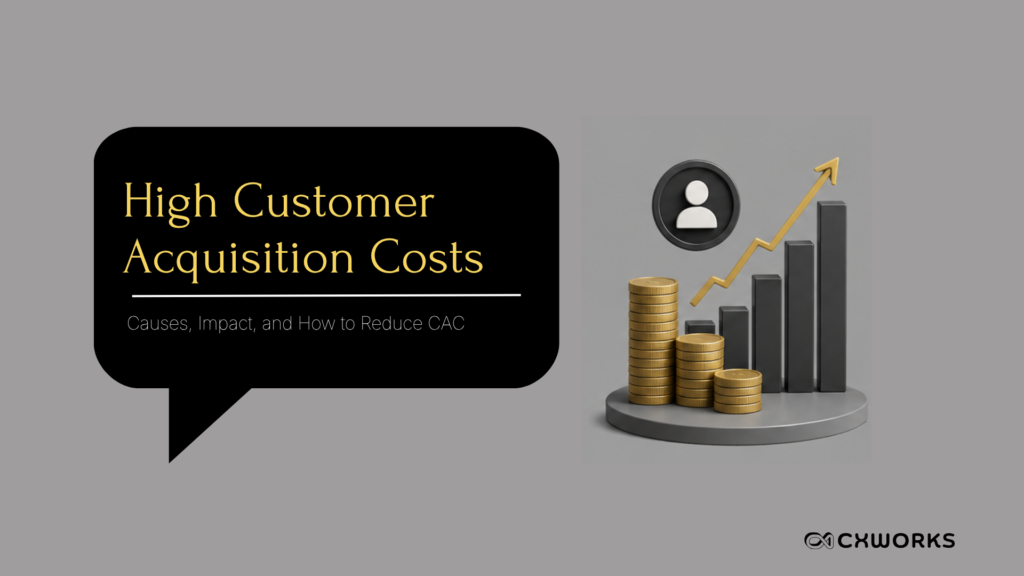
High customer acquisition costs are becoming a major profitability challenge for eCommerce businesses. As paid media platforms become more competitive, acquisition channels become more expensive, and customer expectations increase, brands must improve how they attract, convert, and retain customers. Customer acquisition cost in eCommerce measures how much a business spends to gain a new customer. A rising CAC directly affects profitability because businesses must recover acquisition investment through repeat purchases, higher order values, or improved retention.
For digital commerce teams, reducing CAC requires more than lowering advertising budgets. It requires better conversion performance, stronger customer insights, improved merchandising, accurate attribution, and a clearer understanding of customer lifetime value (CLV).
What Is Customer Acquisition Cost (CAC) in eCommerce?
Customer acquisition cost (CAC) represents the average marketing and sales investment required to acquire one new customer. eCommerce teams use CAC to evaluate the efficiency of acquisition channels, campaigns, and customer acquisition strategy for eCommerce growth. A business with increasing CAC must understand whether higher costs come from paid media inflation, declining conversion rates, poor audience targeting, or weak customer retention.
CAC Formula and How eCommerce Businesses Calculate Acquisition Costs
The customer acquisition cost formula is:
CAC \= Total Marketing and Sales Costs ÷ Number of New Customers Acquired
For example, if an eCommerce brand spends $50,000 across paid advertising, marketing technology, and campaign management while acquiring 1,000 new customers, the CAC equals $50. However, CAC alone does not show profitability. Businesses must compare CAC against customer lifetime value (CLV), which measures the total revenue contribution expected from a customer relationship.
Difference Between Customer Acquisition Cost and Customer Lifetime Value (CLV)
Customer acquisition cost vs customer lifetime value is one of the most important comparisons for eCommerce profitability. CAC measures the investment required to gain customers. CLV measures the long-term financial contribution those customers generate. A healthy CLV:CAC ratio indicates that acquisition spending creates sustainable growth. A declining ratio signals that brands may be paying too much to acquire customers who generate limited future revenue.
Why Rising CAC Has Become a Strategic Challenge for eCommerce Teams
Rising customer acquisition costs create pressure across marketing, finance, and growth teams. Higher acquisition expenses reduce margins, extend CAC payback periods, and increase dependence on repeat purchases. Many eCommerce growth challenges now come from balancing customer acquisition with profitability. Brands must improve the full customer journey instead of relying only on increasing advertising spend.
Why Are Customer Acquisition Costs Increasing in eCommerce?
Several market shifts contribute to high customer acquisition costs across online retail.
Rising Paid Media Competition and Higher Advertising Costs
Paid advertising costs for eCommerce have increased as more brands compete for the same customer attention across search and social platforms. Paid search costs and social advertising costs continue to influence acquisition efficiency because businesses often compete for high-intent audiences with similar targeting strategies. Performance marketing teams must improve paid media efficiency by analyzing campaign quality, landing page performance, audience segments, and conversion outcomes.
Reduced Third-Party Data Access and Targeting Limitations
Changes in privacy regulations and browser restrictions have reduced access to third-party customer data. These changes affect audience targeting accuracy and make customer acquisition more difficult. First-party data has become important because brands can use customer behavior, purchase history, and engagement signals to create stronger audience segments.
Declining Organic Reach Across Search and Social Channels
Organic traffic growth has become more competitive as search results include more commercial content, marketplace listings, and paid placements. Brands that invest in SEO, content strategy, technical improvements, and customer-focused resources can create additional acquisition channels beyond paid media.
Increased Customer Expectations for Personalized Experiences
Customers expect relevant product recommendations, personalized communication, and efficient shopping journeys. Poor personalization can increase acquisition costs because customers leave websites without purchasing after interacting with irrelevant content, unclear navigation, or weak product discovery.
Poor Conversion Rates Across Digital Commerce Touchpoints
A low website conversion rate increases CAC because businesses spend money attracting visitors who do not convert. Conversion issues often appear across product pages, search functionality, checkout flows, mobile experiences, and customer journeys.
How High CAC Impacts eCommerce Growth and Profitability
High acquisition costs affect more than marketing budgets. They influence business scalability, customer economics, and long-term growth.
Lower Marketing Efficiency and Reduced Return on Ad Spend (ROAS)
Higher CAC reduces marketing efficiency because businesses receive less revenue from each acquisition dollar. A campaign may generate significant traffic but still create poor financial outcomes if visitors fail to convert or purchase only once.
Longer Payback Periods for Customer Acquisition Investments
CAC payback period measures how long a business takes to recover acquisition spending through customer revenue. Longer payback periods create cash flow pressure because businesses invest upfront before recovering customer value.
Increased Pressure on Customer Retention and Repeat Purchases
When acquisition costs rise, retention marketing becomes more important. Brands improve profitability by increasing repeat purchase rate, improving customer engagement, and building stronger post-purchase experiences.
Limited Ability to Scale Customer Growth Profitably
Businesses cannot scale acquisition indefinitely if customer economics continue to decline. Sustainable growth requires improving conversion rates, customer segmentation, retention, and acquisition channel performance together.
How to Diagnose the Root Causes of High Customer Acquisition Costs
Reducing CAC starts with identifying where customer acquisition inefficiencies occur.
Analyze Customer Acquisition Data Across Marketing Channels
eCommerce teams should evaluate acquisition channels using marketing attribution models, campaign performance data, and customer behavior insights. GA4 analytics helps teams understand user journeys, traffic sources, conversion paths, and revenue contribution from different channels.
Identify Conversion Rate Optimization (CRO) Gaps
Conversion rate optimization (CRO) improves the percentage of visitors who complete valuable actions, such as purchases or sign-ups. CRO analysis examines website usability, checkout optimization, page performance, messaging, and customer behavior patterns. Testing platforms such as VWO help teams validate improvements through structured experimentation.
Evaluate Customer Segments Using RFM Analysis
RFM analysis segments customers based on recency, frequency, and monetary value. This approach helps businesses identify valuable customer groups, improve retention campaigns, and allocate acquisition budgets more effectively.
Measure Customer Lifetime Value Against Acquisition Spend
Businesses should analyze CLV alongside CAC to understand whether acquisition investment creates sustainable customer relationships. Improving CAC and CLV ratio requires better acquisition targeting, stronger retention programs, and improved customer experiences.
How eCommerce Businesses Can Reduce Customer Acquisition Costs
Reducing CAC requires improvements across acquisition, conversion, and retention.
Improve Website Conversion Rates Through CRO Testing
CRO testing helps identify barriers that prevent visitors from completing purchases. Improved product information, faster pages, stronger trust signals, and simpler checkout experiences can increase conversion efficiency.
Build More Efficient Customer Segmentation and Personalization
Customer segmentation allows brands to group audiences based on behavior, preferences, and purchase patterns. Personalized experiences improve relevance and can increase engagement across acquisition and retention campaigns.
Strengthen Organic Acquisition Through SEO and Content Strategy
SEO creates long-term acquisition opportunities by improving visibility for customer searches. Content strategy, technical SEO, internal linking, and helpful resources support organic traffic growth and reduce dependence on paid channels.
Improve Product Discovery and Merchandising Experiences
Merchandising optimization improves how customers find and evaluate products.Better search, filtering, recommendations, category structures, and product ranking help customers reach relevant products faster.
Increase Retention Through Lifecycle Marketing
Lifecycle marketing connects customer communications with different stages of the buying journey. Email campaigns, behavioral messaging, loyalty programs, and post-purchase engagement help improve repeat purchase rate.
The Role of Analytics in Reducing eCommerce CAC
Analytics provides the foundation for better acquisition decisions. GA4 analytics, customer data analysis, and performance measurement help businesses understand which channels, audiences, and experiences create profitable customers. Marketing attribution helps teams identify revenue contribution across multiple touchpoints instead of evaluating channels in isolation. CLV modeling helps businesses determine how much acquisition investment makes financial sense for different customer segments.
How CXWorks Helps eCommerce Businesses Reduce Customer Acquisition Costs
CXWorks helps eCommerce businesses improve acquisition efficiency through digital customer experience strategy, analytics, conversion optimization, and merchandising improvement. The consultancy approach connects customer behavior data with practical improvements across digital commerce experiences.
Conversion Rate Optimization and Digital Experience Improvement
CXWorks helps businesses identify conversion barriers through customer journey analysis, CRO testing, and website experience evaluation. Improving conversion performance allows businesses to generate more revenue from existing traffic sources.
Analytics, Customer Insights, and Performance Measurement
CXWorks supports businesses with analytics frameworks that connect customer behavior, marketing performance, and commercial outcomes. Data-driven insights help teams make better decisions about acquisition channels, customer segments, and growth investments.
Merchandising Optimization and Customer Journey Improvements
CXWorks helps businesses improve product discovery through merchandising optimization and customer experience analysis. Better customer journeys help visitors find relevant products, reduce friction, and improve purchase confidence.
Frequently Asked Questions About High Customer Acquisition Costs in eCommerce
A high customer acquisition cost depends on product margins, average order value, retention rate, and customer lifetime value. A CAC becomes problematic when acquisition spending exceeds the long-term financial contribution of customers.
eCommerce CAC increases because paid media competition, advertising costs, weaker targeting, declining conversion rates, and customer expectations affect acquisition efficiency.
eCommerce brands can lower CAC by improving conversion rates, strengthening SEO, using customer segmentation, optimizing merchandising, and increasing retention.
Conversion rate optimization reduces CAC by helping more website visitors become customers without requiring additional acquisition spend.
eCommerce teams should track CAC alongside CLV, CLV:CAC ratio, CAC payback period, conversion rate, ROAS, repeat purchase rate, and retention metrics.